UN Sustainable Development Goals
Empowering communities, driving green industrialization, and eradicating poverty through technical education in the Oti Region.
TVET as an Engine for the UN Sustainable Development Goals
Technical and Vocational Education and Training is widely recognized by the United Nations and the African Union as the primary catalyst for achieving the 17 Sustainable Development Goals (SDGs). In the Oti Region, our programmes and infrastructure projects directly advance these global targets by transforming raw agricultural potential into industrial capability.
Oti TVET Direct SDG Targets
Goal 1: No Poverty
Equipping underprivileged and rural youth with marketable vocational skills to secure self-employment, lift families out of intergenerational poverty, and generate rural wealth.
Goal 2: Zero Hunger
Scaling practical school agriculture and mechanized farming at Fr. Dogli Memorial Tech and regional centres to feed schools, curb local food inflation, and boost nutrition.
Goal 4: Quality Education
Providing free, high-quality, competency-based pre-tertiary technical education aligned with international occupational standards and the Pre-Tertiary Education Act 2020.
Goal 5: Gender Equality
Actively breaking gender stereotypes by enrolling and mentoring young women in traditionally male-dominated trades such as electrical engineering, welding, and building construction.
Goal 8: Decent Work & Economic Growth
Directly linking technical graduates with industrial internships, master-craft apprenticeships, and cooperative enterprise incubation for sustainable livelihoods.
Goal 9: Industry, Innovation & Infrastructure
Constructing modern workshops, introducing computer hardware and renewable solar installations across all 9 municipal and district assemblies in the Oti Region.
Goal 17: Partnerships for the Goals
Forging multi-stakeholder civil society partnerships through the NARNGO Strategic Consortium to mobilize resources and complement national government investments.
UNCT Ghana SDGs Advocacy Messages Report
Download the official United Nations Country Team (UNCT) Ghana advocacy document detailing sustainable development priorities, indicators, and youth capacity building frameworks [2.70 MB].
Administrative Structure of the Region
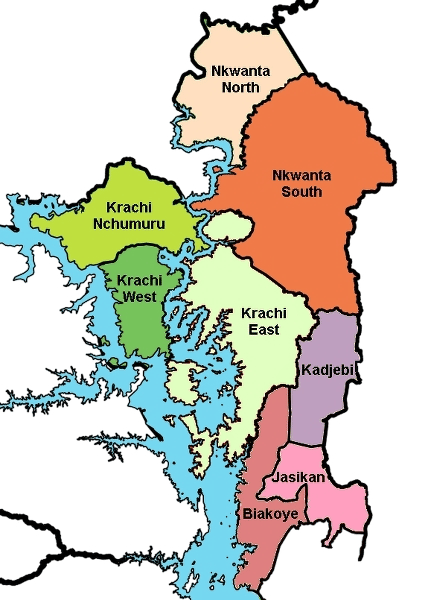
As specified in CI 112 of 2019, the Oti Region is made up of eight (8) existing administrative districts and the SALL Area consisting of the four Traditional Areas of Santrokofi, Akpafu, Lolobi, and Likpe which have just been constituted into a new District called Guan with its Capital at Likpe Mate. The Guan District is yet to be inaugurated. The Regional Coordinating Council: The Regional Coordinating Council was inaugurated in July 2019. The composition consists of the Regional Minister, the Municipal and District Chief Executives and Presiding Members of the 8 Municipal and District Assemblies, Two Representatives of the Regional House of Chiefs, and the Regional Heads of Departments who are ex-officio members.
- Jasikan District – Capital: Jasikan
- Biakoye District – Capital: Nkonya Ahenkro
- Kadjebi District – Capital: Kadjebi
- Nkwanta South Municipality – Capital: Nkwanta
- Nkwanta North District – Capital: Kpassa
- Krachi East Municipality – Capital: Dambai
- Krachi West District – Capital: Kete Krachi
- Krachi Nchumuru District – Capital: Chinderi
- Guan District (SALL Area) – Capital: Likpe Mate(Yet to be inaugurated)